George Okewa

Okewa is the Director of Community Relations at SHOFCO, bringing deep grassroots experience to his work organizing around community issues and leading slum-wide campaigns for sanitation, safety, and justice.
Most people know SHOFCO for our work in places like Kibera.
Look at those arial pipes! Incredible girls’ academies! Bustling health clinics! It’s all very urban. Yes, that is how SHOFCO started, but you notice, we don’t talk about just urban promise from urban poverty anymore. One of my favorite parts of SHOFCO’s work is a piece that people know very little about: our agriculture and climate work in the rural communities that so many of our members call home.
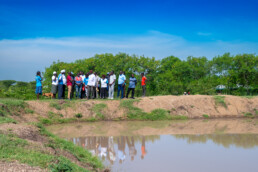
When I first joined the SHOFCO Urban Network, my days were full of community meetings, sanitation drives, and advocacy trainings. Then one day, I was sent to Siaya to help organize a small farmers’ group that had started experimenting with drought-tolerant maize. I thought I was going for a quick site visit. Instead, I found myself standing by a newly built water pan — a wide, shallow bowl of collected rainwater and river runoff — surrounded by farmers comparing the color of their maize leaves. This made me realize, this work isn’t just about water or food or just improving our cities. It’s about dignity.
Over the past year, our teams have been building that dignity, one small victory at a time. Through SHOFCO, more than 100,000 farmers have received drought-resistant seeds. In Migori, Siaya, and Homa Bay, we’ve installed more than 50 water pans. Each pan captures the rain that used to wash away our soil or river runoff that would otherwise overflow and risk flooding. They’re big enough to serve entire villages, watering small kitchen gardens and keeping livestock alive through the dry months. When you visit after the long rains, you can smell a difference in the air – and there is so much green that covers our hard, clay soil. It was not always like this.
I am always asked, what is ‘climate resilience’? For me, it’s a mother in Busia planting cassava beside her maize, knowing this year she won’t have to watch her children skip meals plus will have extra to sell. It’s the group of youth in Mombasa who turned plastic waste into eco-briquettes and now sell them in the market — that’s waste to wages. It’s other youth in Homa Bay who saw spoiled produce at the market and decided to compost it into fertilizer instead of letting it rot. Every time I visit, someone has turned an obstacle into an idea.
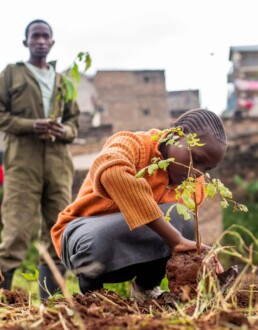
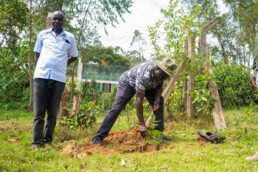
In October, I helped Erick Chweya, our CBO and Climate lead, coordinate Mazingira Day activities across seven counties. SHOFCO’s family has grown so much. In Siaya, we planted mango and avocado seedlings beside schools; in Kakamega, the youth dug holes for indigenous trees; in Mombasa, women carried buckets of soil on their heads, and sang as they worked. By the end of the day, we had planted almost 5,000 trees nationwide.
Face to Face
In our communities, climate change is something that we must meet face-to-face. We did nothing to cause this change, but we are certainly bearing the brunt of the impact. Floods sweep through Mathare. Droughts that crack the earth in Kitui. There is a power in adaptation and a people that refuse to give up. We come together to dig, plant, rebuild, and teach. That’s what SHOFCO means to me: a bridge between where we live and the future we deserve.
Sometimes, when I’m back in Nairobi, people ask me how SHOFCO is doing. I know they’re expecting to hear about the schools or the water kiosks. Everyone loves the arial piping because it’s right in your face – so easy to see. Instead, I tell them about the seedlings in Siaya and the farmers in Homa Bay. About how, in a place where people thought nothing could grow, we are growing everything — food, trees, and possibility. Hope can be planted.
The work you don't see
The work you don’t see is often the work that lasts the longest. It’s quiet. It doesn’t make headlines. But when you walk in the red dust of a SHOFCO water pan or under the shade of our new trees, you can feel it: the climate is changing, but so are we. We are built for adaptation. Nobody does it better.