Sylvia Odhiambo

Sylvia works as Governance and Advocacy Associate at SHOFCO, championing community voice and civic engagement across SHOFCO’s programs.
This year, I witnessed something remarkable. I will not forget it.
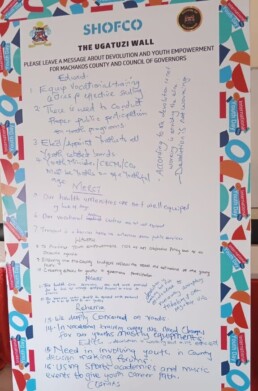
Across Kenya, young people gathered in schools, community halls, and open spaces to speak about what matters most to them. From Mombasa to Turkana, from Kibera to Kisumu, they added their voices—literally—onto the Ugatuzi Wall, a huge mobile mural that traveled county to county collecting youth opinions on governance, health, jobs, and inclusion.
This was our Mtaani Youth Tour, and by its conclusion, we had heard from thousands of youth across all counties. The energy was electric. Finally, young people weren’t being spoken for—they were shaping the agenda themselves.
From Conversations to Collective Power
Those ideas became the foundation of something bigger: the Youth Agenda, a ten-point blueprint co-created by young Kenyans through SHOFCO’s pre-Devolution Conference activities under the SHOFCO Urban Network (SUN). Kenya’s government is devolved, meaning power is shared between the national government and 47 county governments, and each year some counties hold a Devolution Conference to assess the progress and struggles encountered by devolution.
We didn’t stop at conversation. We convened a National Youth Baraza, bringing together youth representatives and county leaders—Governors, policy experts, and civil society partners—for direct dialogue. We spoke openly about jobs, education, and mental health. One young woman stood up and said, “We keep being told to be resilient—but resilience without opportunity is just suffering.” Everyone went quiet. Then we all applauded.
We knew then the Youth Agenda wasn’t just a document—it was a mandate.

In August, we presented this ten-point Youth Agenda to the Council of Governors (CoG) during the Devolution Conference. Standing there, surrounded by the same young people who had shaped it from their neighborhoods, I felt proud—and nervous. Would the policymakers listen? Would they act?
Just weeks later, during his keynote address, Cabinet Secretary (CS) for Health, Hon. Aden Duale, announced that one of our top priorities—mental health for youth—had been integrated into Kenya’s Universal Health Coverage (UHC) through the Taifa Care Model and Social Health Authority (SHA).
For context: that means mental health care is now officially recognized as a core national service, available through the public insurance package. This shift, guided by the Mental Health Act (2023) and Kenya’s Mental Health Policy, ensures that every young person—no matter where they live—can access quality, affordable mental health support.
Hearing the Health CS echo our demands in his speech—calling for the decentralization of mental health services to the grassroots and support for 107,000 Community Health Promoters—was surreal. For the first time, I saw our collective advocacy reflected in national policy language.
What this Means for Us
For me, this wasn’t just a policy win. It was proof that youth organizing works. That civic participation, when grounded in lived experience, can move institutions.
Through SHOFCO’s model, the Youth Agenda went from community conversations to national influence. It showed that when youth lead with clarity, data, and unity, they can transform frustration into legislation.
I often think back to those first gatherings, when young people scribbled their hopes on the Ugatuzi Wall.
They looked like decoration, but they were direction. Today, they are shaping government priorities.
On the Table
That’s what it means to move from voices on the wall to policy on the table. It’s not just symbolism—it’s systemic change, driven from the grassroots up. And as SHOFCO youth leaders, we’re only getting started.